Table of Contents
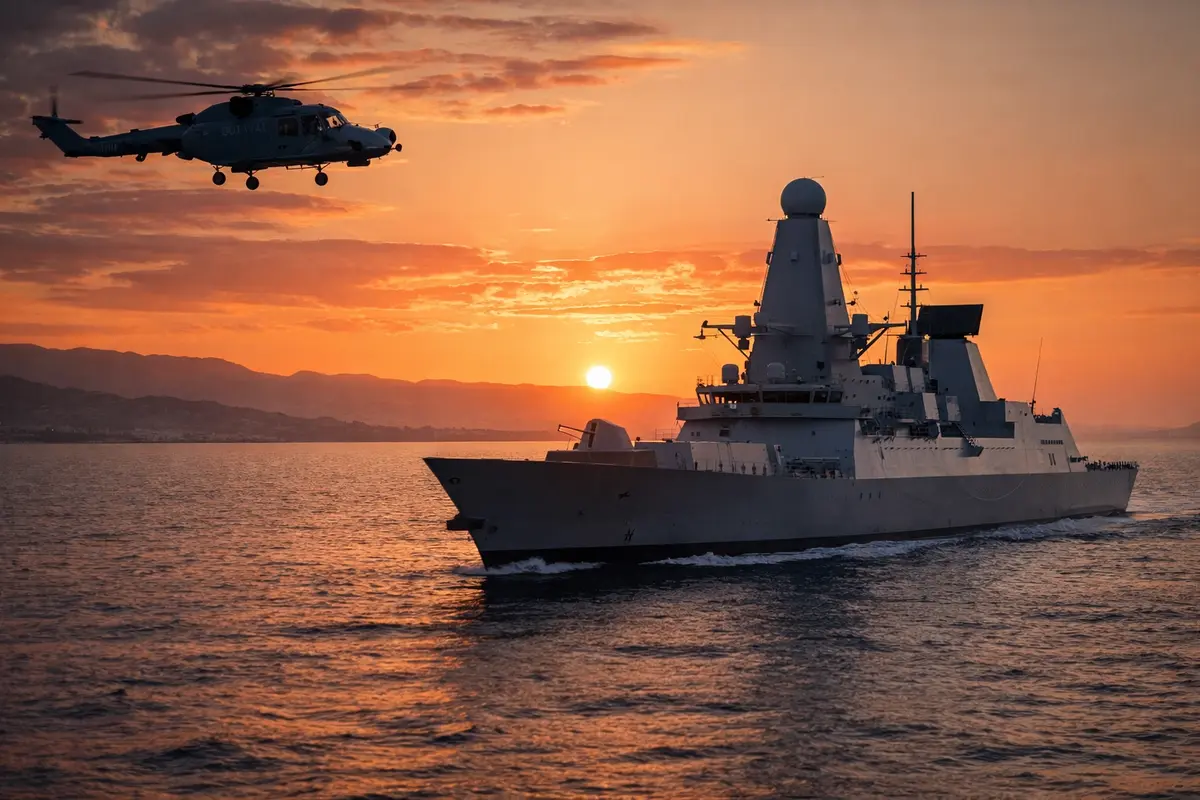
The United Kingdom has announced that it will deploy a Royal Navy warship to the eastern Mediterranean. The ship, HMS Dragon, will strengthen security around the British air base at RAF Akrotiri in Cyprus. This move comes as tensions continue to rise in the Middle East following military strikes between the United States, Israel, and Iran.
Prime Minister Keir Starmer confirmed the decision as part of a wider effort to protect British forces and allies in the region. The deployment follows a recent drone strike that hit the runway at RAF Akrotiri. The British Ministry of Defence said the strike caused only minimal damage, but it raised serious concerns about the safety of military facilities.
In addition to the warship, the UK will send two Royal Navy Wildcat helicopters. These helicopters carry Martlet missiles designed to destroy drones and other aerial threats. The deployment shows how the UK is strengthening its defensive position as regional tensions grow.
This article explains why HMS Dragon is being sent to Cyprus, the importance of RAF Akrotiri, the growing threat of drone warfare, and how the wider conflict in the Middle East is shaping military decisions.
Rising Tensions Across the Middle East
The current crisis began after military strikes carried out by the United States and Israel against Iranian military targets. These attacks aimed to weaken Iran’s missile infrastructure and military facilities. Iran responded with drone and missile strikes across several areas in the region.
These attacks created serious concern for countries that have military bases in the Middle East. Many Western nations maintain forces in the region for security operations, intelligence work, and support for allies. When drone attacks began to increase, these bases suddenly faced a higher level of risk.
The situation quickly became tense. Governments across Europe and the Middle East began reviewing their defence plans. Military forces increased patrols and strengthened air defence systems. Several countries moved aircraft and ships closer to potential conflict zones.
The United Kingdom is one of the nations with strong military presence in the region. British bases support operations across the Middle East. Because of this role, protecting those bases became a top priority.
Drone Strike on RAF Akrotiri
A major reason for the deployment of HMS Dragon was a drone strike on RAF Akrotiri in Cyprus. The attack targeted the runway of the base. According to the Ministry of Defence, the strike caused only minor damage and no injuries.
Despite the limited damage, the attack raised serious concerns among defence officials. RAF Akrotiri is one of Britain’s most important overseas military bases. It plays a central role in air operations across the Middle East.
The drone strike showed that British facilities could become targets during the conflict. Even a small attack on a runway could disrupt air missions or surveillance flights. Military leaders therefore decided that stronger protection around the base was necessary.
The deployment of a powerful naval destroyer near Cyprus will provide an additional layer of defence. Naval radar and missile systems can help detect and intercept aerial threats before they reach the base.
HMS Dragon and Its Capabilities
HMS Dragon is one of the Royal Navy’s most advanced warships. It belongs to the Type 45 destroyer class, which is designed for air defence missions. These ships are built to protect fleets and strategic locations from missile and aircraft attacks.
The destroyer carries powerful radar systems that can track threats from long distances. Once a threat is detected, the ship can launch missiles designed to destroy incoming targets.
According to the Ministry of Defence, HMS Dragon can fire eight missiles in less than ten seconds. This rapid response ability makes the ship highly effective against drone swarms or missile attacks.
The ship is operated by a crew of more than 200 sailors. These personnel manage radar systems, weapons, navigation, and communications.
Once it arrives in the eastern Mediterranean, HMS Dragon will help monitor the airspace around Cyprus. Its mission will focus on protecting RAF Akrotiri and supporting allied defence operations.
Royal Navy Wildcat Helicopters
Alongside the destroyer, the UK will deploy two Royal Navy Wildcat helicopters. These aircraft play an important role in modern naval defence.
The helicopters are equipped with Martlet missiles. These missiles are designed to destroy small aerial targets such as drones.
Drones have become one of the most common threats in modern conflicts. They are relatively cheap to produce and can travel long distances. Many drones fly low to the ground, which makes them harder to detect.
The Wildcat helicopters will patrol the area around Cyprus and nearby waters. Their mission will be to detect and intercept drones before they reach British bases or ships.
The helicopters also provide flexibility. They can respond quickly to threats that appear outside the range of ground-based defence systems.
Importance of RAF Akrotiri
RAF Akrotiri is one of Britain’s most important overseas military bases. The base is located on the southern coast of Cyprus. Its position allows aircraft to reach the Middle East quickly.
The base supports surveillance missions, intelligence gathering, and military operations. British aircraft often operate from this location during missions across the Middle East.
During previous conflicts in Iraq and Syria, RAF Akrotiri played a major role in air operations. Fighter jets, reconnaissance aircraft, and support planes launched from this base.
Because of its strategic location, the base is essential for British defence planning in the region. Protecting it is therefore a major priority.
The recent drone strike demonstrated how vulnerable even well-protected bases can be. Strengthening air defence around the base is now considered necessary.
Type 45 Destroyers and Royal Navy Strength
HMS Dragon belongs to a group of warships known as Type 45 destroyers. These ships are considered among the most capable air defence vessels in the world.
Their main role is to protect fleets and strategic sites from aerial threats. This includes missiles, aircraft, and drones.
The Royal Navy currently operates six Type 45 destroyers. However, not all ships are available for deployment at the same time. Some ships undergo maintenance or upgrades.
Only a few are ready for immediate deployment at any moment. Sending HMS Dragon to Cyprus shows that the UK sees the situation as serious.
The destroyer’s radar and missile systems provide strong protection for nearby ships and bases.
British Military Operations in the Region
British forces have already been active in recent days across the Middle East. The Ministry of Defence reported that UK forces shot down several drones over Iraq, Jordan, and Qatar.
In Jordan, RAF F-35B fighter jets destroyed drones during an operational mission. This marked the first time this type of aircraft had shot down targets during active operations.
These jets worked alongside Typhoon fighter aircraft and a Voyager tanker aircraft that provided mid-air refuelling.
In Iraq, British forces used ground-based counter-drone systems to intercept incoming drones aimed at coalition bases.
Another drone believed to be Iranian was destroyed by a Typhoon jet near Qatar.
These events show how drone attacks have become a frequent threat in the region.
Allied Support for Cyprus
The United Kingdom is not the only country responding to the crisis. Several European allies have also announced military support for Cyprus.
France has said it will send its aircraft carrier Charles de Gaulle to the Mediterranean. The carrier will help strengthen air defence and support allied operations.
France will also deploy a frigate equipped with advanced air defence systems.
Greece has also announced military support for Cyprus. Greek forces will send four F-16 fighter jets and two naval frigates.
One of these ships carries the Centauros anti-drone jamming system. This technology can detect and disable low-flying drones.
These moves show strong cooperation among European allies in defending Cyprus.
Political Reactions and Debate
The deployment of HMS Dragon has sparked discussion among political observers. Some critics question why the Royal Navy did not send a destroyer to the region earlier.
The United States had already increased its military presence in the area. Some analysts say a stronger naval presence from the UK could have been placed there sooner.
Prime Minister Keir Starmer defended the government’s decision. He said the UK will always act to protect its forces and allies.
Starmer also expressed strong support for Cyprus and its security.
The British government views Cyprus as an important partner in regional defence.
Growing Role of Drone Warfare
Drone warfare has become a major feature of modern conflicts. Small unmanned aircraft can travel long distances and carry explosive payloads.
They can fly low and avoid radar detection. This makes them difficult to intercept using traditional defence systems.
Because drones are relatively cheap to produce, many armed groups now use them.
Recent attacks across the Middle East show how effective drones can be against military bases.
Countries are investing heavily in counter-drone technology. Radar systems, missiles, and electronic jamming tools are used to stop drone attacks.
The deployment of Martlet missiles and Type 45 destroyers reflects this new focus on air defence.
Key Information About the Deployment
| Topic | Details |
|---|---|
| Warship Name | HMS Dragon |
| Ship Type | Type 45 Destroyer |
| Deployment Area | Eastern Mediterranean near Cyprus |
| Mission | Protect RAF Akrotiri and strengthen air defence |
| Crew | Over 200 sailors |
| Key Capability | Launch eight defence missiles in under ten seconds |
| Additional Support | Two Wildcat helicopters with Martlet missiles |
| Reason | Drone strike on RAF Akrotiri and rising regional tensions |
What Could Happen Next
The Middle East situation remains tense and unpredictable. Military deployments may increase if the conflict continues to escalate.
More naval ships, aircraft, and defence systems could move into the region. Governments are trying to prevent the conflict from spreading further.
Diplomatic talks may also play an important role in reducing tensions. Many countries hope negotiations will prevent a larger war.
For now, protecting military bases and personnel remains the main focus.
The presence of HMS Dragon will strengthen the defence of RAF Akrotiri and support allied forces operating in the region.