Table of Contents
A sudden rise in military tension in the Middle East left thousands of travellers stranded and searching for safe ways home. The conflict began after strikes involving the United States, Israel, and Iran triggered retaliation across several countries in the region. Missile attacks, airspace closures, and airport disruptions caused panic among tourists and foreign residents.
Among those affected were British citizens living or visiting countries such as the United Arab Emirates. Many were forced to leave quickly as security concerns increased. Some people drove across borders while others waited days for evacuation flights arranged by their government.
The United Kingdom launched emergency evacuation operations to help its citizens leave the region safely. One of the first charter flights organised by the government departed from Muscat, the capital of Oman. The flight carried British nationals who had travelled from nearby countries hoping to escape the crisis.
Passengers who arrived in London described the experience as surreal. Many had rushed across borders with little time to plan. Others spent nights in shelters or airports while waiting for a safe flight.
This situation shows how quickly global travel can change during a conflict. The evacuation flight from Oman became an important step in helping citizens return home.
Rising Conflict and Regional Tension
The crisis began when military strikes targeted Iranian sites. Iran responded with missile and drone attacks across parts of the Middle East. Several countries quickly felt the effects of this retaliation.
Cities in the Gulf region reported explosions and air raid warnings. Dubai, a major global travel hub, experienced direct strikes that caused damage in some areas. Reports mentioned damage near the international airport and luxury hotels.
The sudden escalation created fear among residents and visitors. Tourists who had arrived only days earlier found themselves caught in a tense situation.
As attacks spread across the region, many governments warned their citizens to stay alert and prepare for travel disruptions. Airlines began cancelling flights because airspace in several countries was closed or restricted.
Countries such as Iran, Iraq, Qatar, Bahrain, Kuwait, Saudi Arabia, Syria, Israel, and the United Arab Emirates saw partial or full airspace shutdowns. These restrictions made it difficult for commercial airlines to operate safely.
The closures affected global travel routes because the Middle East sits between Europe, Asia, and Africa. Flights normally pass through this region when connecting major international destinations.
As commercial flights stopped operating, governments began preparing emergency evacuation plans.
Oman Becomes a Safe Exit Route
During the crisis, Oman became one of the safest exit routes for people trying to leave the region.
Oman sits on the southeastern side of the Arabian Peninsula. While it shares waters with Iran across the Gulf of Oman, its capital city Muscat is far from Tehran. This distance lowered the immediate risk of missile attacks.
Muscat also lies within driving distance from Dubai, one of the largest cities in the United Arab Emirates. The road journey between Dubai and Muscat is about 280 miles.
Because flights from Dubai were limited, many travellers chose to drive across the border into Oman. The trip often took several hours, but it allowed people to reach a safer location where evacuation flights were available.
Governments from several countries began arranging charter flights from Muscat. These flights helped stranded citizens return home.
Oman’s stable security situation and open airport operations made it a key hub for evacuation efforts.
The First UK Government Evacuation Flight
The United Kingdom organised its first evacuation flight from Muscat for British citizens stranded in the Middle East.
The plane was scheduled to depart from Muscat International Airport on Wednesday night. However, technical problems delayed the flight by almost twenty four hours.
Passengers waited anxiously while officials worked to resolve the issue. Many travellers had already spent days trying to reach Oman.
Eventually the aircraft departed on Thursday night local time. The plane flew directly to London Stansted Airport in the United Kingdom.
It landed shortly after midnight on Friday morning.
The arrival marked the first government organised evacuation flight for British citizens since the conflict began.
For many passengers, boarding the aircraft brought a sense of relief after several days of uncertainty and fear.
Key Details of the Evacuation Situation
| Topic | Information |
|---|---|
| Cause of Crisis | Military strikes involving the US, Israel, and Iran |
| Retaliation | Iranian missile and drone attacks in the region |
| Travel Impact | Airspace restrictions across several Middle East countries |
| Evacuation Hub | Muscat, Oman |
| First UK Evacuation Flight | Government charter flight from Muscat |
| Flight Delay | Technical issues delayed departure |
| Destination | London Stansted Airport |
| Registered British Citizens | More than 140,000 in the region |
| Citizens Already Returned | Thousands evacuated through flights |
Travellers Forced to Leave Quickly
Many travellers had to make fast decisions after hearing news about the attacks.
Fazal Chowdhury, a resident of Dubai, explained how he and his wife reacted immediately when reports of strikes appeared. They decided not to wait and drove directly to Oman.
The couple checked into a hotel in Muscat and waited for evacuation information from the British government.
Chowdhury later said the entire situation felt surreal. Events moved quickly and there was little time to think about long term plans.
After registering with the UK Foreign Office, the couple learned about the government charter flight leaving Muscat. They were fortunate to secure seats.
Like many others, they felt relieved once they were safely on the plane.
Their experience reflects the difficult decisions many travellers faced during the crisis.
Tourists Caught in a Sudden Crisis
Some travellers had only arrived in the region shortly before the conflict began.
Amelia Reid and Samuel Sharp travelled to Dubai for a short weekend break. Their trip was meant to be a relaxing getaway.
Within a day, the situation changed completely.
Emergency alerts appeared on their phones after missile strikes were reported nearby. Hotel alarms sounded and guests rushed to safer areas inside the building.
Many people moved into underground parking areas for protection.
Reid and Sharp spent the night in the basement car park along with about one hundred other people. Guests tried to sleep while waiting for updates about the situation.
The experience left travellers nervous and exhausted.
Sharp later described hearing a loud explosion during breakfast one morning. The sound reminded everyone that the conflict was still active.
For many tourists, the crisis turned a short holiday into a stressful emergency.
Difficult Journey to Reach Oman
Getting out of Dubai and other affected cities was not easy.
Airlines had cancelled many flights because of airspace restrictions. This left road travel as the only realistic option for many travellers.
Families packed their belongings and began long drives toward the Omani border.
Some travellers drove overnight while others travelled in groups for safety. Border crossings became crowded with people trying to leave the United Arab Emirates.
After crossing into Oman, travellers still had to reach Muscat to join evacuation flights.
For some families the journey took several hours.
Many arrived tired and worried about whether they would secure seats on the limited number of flights.
Long Waits at Muscat Airport
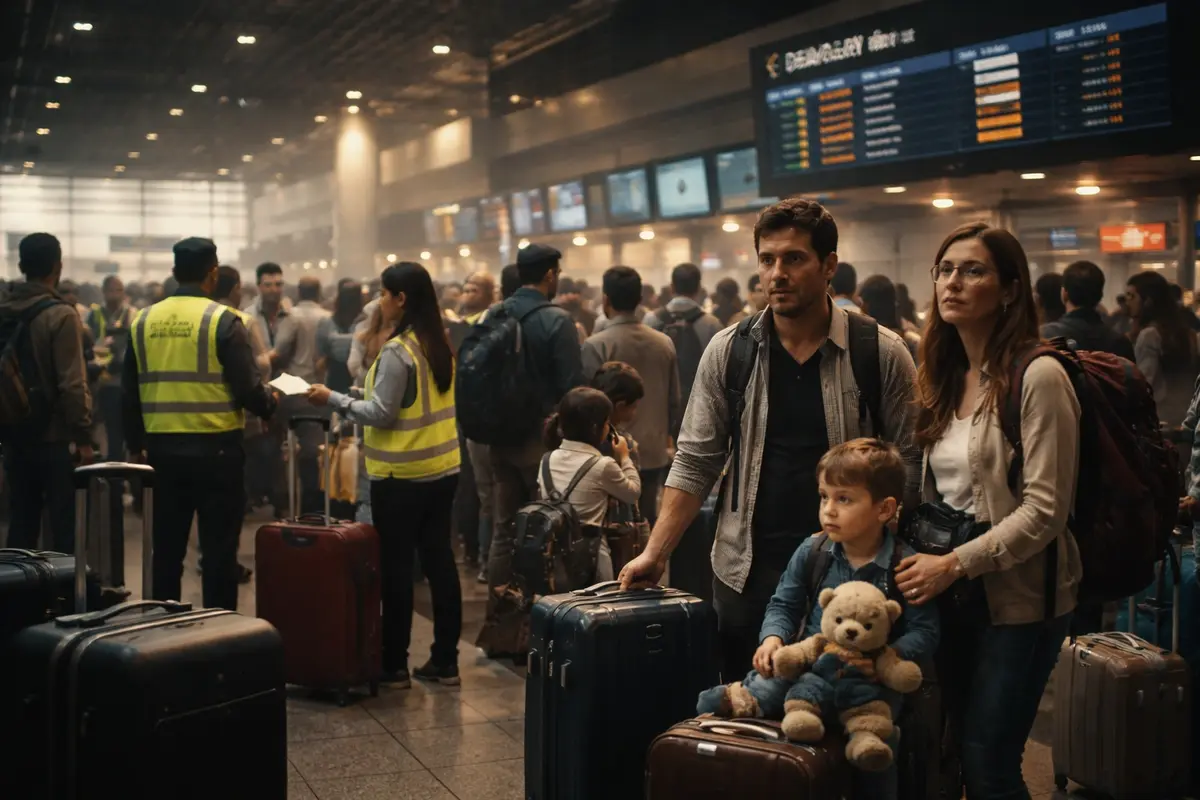
Muscat International Airport soon became busy with travellers from different countries hoping to leave the region.
Some passengers spent more than a day waiting for flights.
One traveller described spending about thirty six hours at the airport with his wife and young child. The family had driven from Dubai and hoped to catch the government charter plane.
The long wait created frustration for many people. Airport seating areas filled quickly as travellers tried to rest.
Parents worked hard to keep children calm during the delays.
Food, water, and basic supplies became important for people who had already travelled long distances.
Despite the stress, most passengers remained patient because the evacuation flights represented their best chance to leave the region safely.
Priority for Vulnerable Citizens
The UK government decided that evacuation seats should go first to vulnerable travellers.
This group included elderly citizens, families with children, people with disabilities, and individuals with medical conditions.
Travellers who required special assistance received priority boarding.
Eligibility for government flights was limited to British nationals and their immediate family members. This included spouses or partners and children under eighteen.
Passengers were asked to register with the Foreign Office before arriving at the airport. Officials advised people not to simply show up without confirmation.
Seats on the government flights were not free. Travellers were expected to pay for the journey.
Even with the cost, many passengers were grateful to have a safe route home.
Government Response and Future Evacuation Plans
The UK government announced plans to increase evacuation capacity in the coming days.
Prime Minister Keir Starmer said more flights would be arranged from Oman to help British citizens leave the region.
Commercial airlines such as British Airways were also expected to operate flights when airspace reopened.
Government officials stated that more than one hundred forty thousand British citizens had registered their presence in the Middle East during the crisis.
Thousands had already returned to the United Kingdom through available flights.
However, officials warned that evacuation efforts depend heavily on airspace conditions. Flights can only operate safely when regional authorities allow aircraft to pass through their airspace.
Diplomatic coordination with other countries also plays a major role in organising evacuation routes.
Impact on Global Travel
The Middle East crisis disrupted international travel in several ways.
Many airlines rely on routes that pass over the Gulf region. When airspace closes, airlines must reroute flights or cancel them entirely.
This situation caused delays across Europe and Asia.
Passengers travelling between continents experienced longer flight times and higher ticket prices due to route changes.
Airlines also faced operational challenges such as fuel costs and aircraft scheduling issues.
Airports in nearby regions saw increased passenger traffic as travellers searched for alternative routes.
Travel experts say the situation highlights how sensitive global aviation networks are to political and military conflict.
Lessons from the Evacuation Experience
The evacuation from Oman offers several lessons about travel safety during international crises.
First, travellers must stay informed about global events before and during their trips. Rapid changes can affect safety and travel plans.
Second, registering with a national embassy or foreign office can help citizens receive emergency assistance. Many British travellers were able to secure evacuation seats because they had registered their presence in the region.
Third, flexible travel plans are important during uncertain situations. Some travellers reached safety only because they were willing to drive long distances or change their plans quickly.
Finally, government evacuation efforts require coordination between many countries. Safe routes, airport access, and aircraft operations must all work together to ensure successful evacuations.