Table of Contents
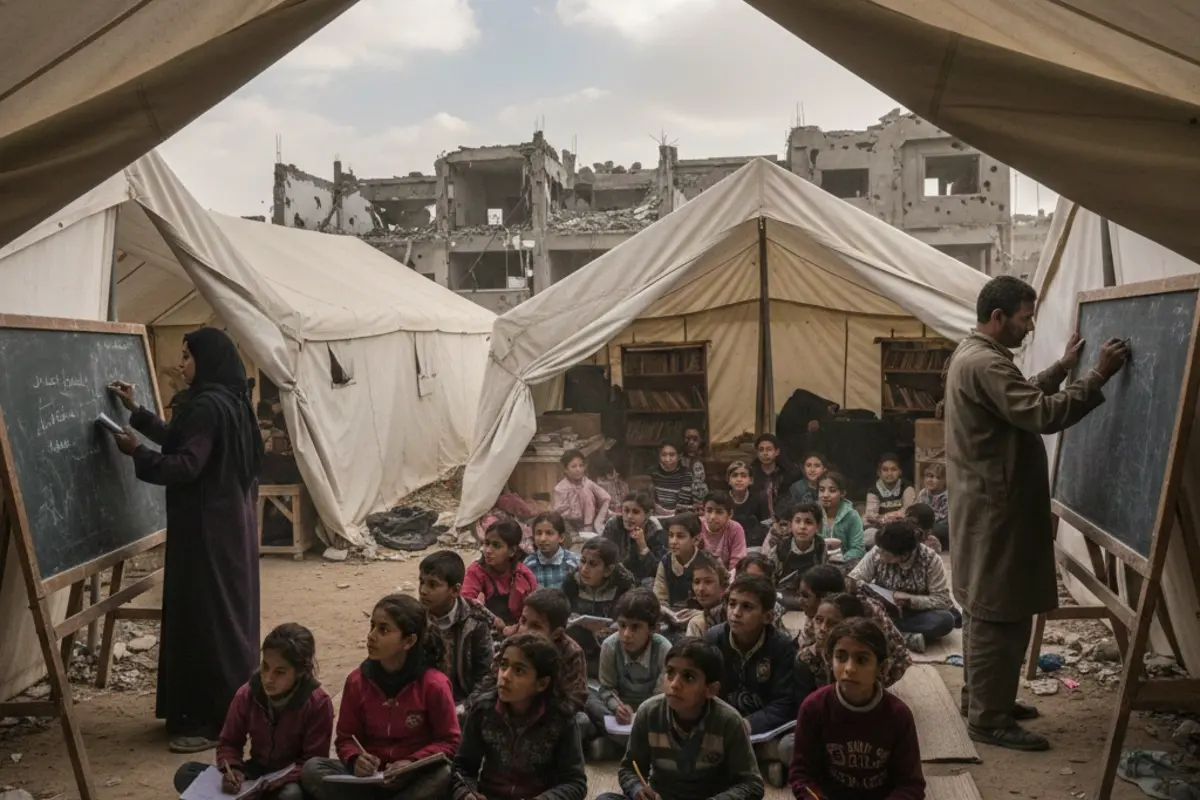
In Gaza City, a sound long missing has returned. Children are learning again. Their voices rise from tents that now serve as classrooms. The noise is uneven and messy, but it carries hope. Teachers point at boards with English letters. Others help pupils write simple Arabic words. It is not a normal school day. But after years of war, it is a beginning.
This return follows a ceasefire that took effect in October. For many children, this is the first taste of routine since the fighting began. The classrooms stand among ruins. The place was once a real school. Now it is a fragile learning space made from tents and basic tools. Still, the children arrive with smiles. That alone shows how much education matters.
A School Rises From Rubble
The learning site stands on the grounds of Lulwa Abdel Wahab al-Qatami School in Gaza City. The school sits in the Tel al-Hawa area in the city’s south-west. It was hit in January 2024. After the strike, the area became a shelter for displaced families. Tents covered the playground. Fear replaced lessons.
Today, those tents serve a new purpose. Children walk in lines with arms on each other’s shoulders. They laugh as they enter class. The setting is basic. The goal is simple. Give children structure again. For many, this is their first step back into education since the war started.
A Lost Generation of Learners
The scale of the education crisis in Gaza is severe. According to Unicef, more than 97 percent of schools were damaged or destroyed during the war. Entire districts lost every learning space. Children stayed home, moved from shelter to shelter, or lived in camps.
Gaza has about 658,000 school-aged children. Most have had no formal education for nearly two years. During this time, many faced hunger, fear, and loss. They learned about death before they learned math. They grew older without classrooms, exams, or school bells.
The return to learning does not erase that damage. But it offers a small chance to rebuild what was lost.
Life Lessons No Child Should Learn
The war shaped children in ways that cannot be measured by grades. Many saw their homes destroyed. Many lost family members. Others lived through repeated displacement. Trauma became part of daily life.
These experiences changed how children see the world. School once meant books and friends. Now it also means safety, routine, and relief from fear. Sitting in class gives them time to breathe. It fills hours that might otherwise be filled with worry.
This return to school is not only about education. It is about healing.
Naeem’s Story of Loss and Return
Fourteen-year-old Naeem al-Asmaar once studied at this school. He remembers the classrooms before the war. He remembers desks, walls, and quiet lessons. Those memories now feel distant.
During the war, Naeem lost his mother in an air strike. He speaks softly when he talks about it. The loss changed him. Displacement followed. His family moved from place to place. For months, there was no school and no routine.
After the ceasefire, Naeem returned home. His house survived. That return allowed him to come back to school as well.
He says school is not the same. The classrooms are tents. Only four subjects are taught. Space is limited. Still, he says being there matters. School fills his day. It gives him focus. After everything he lost, structure helps him cope.
Dreams That Refuse to Fade
Rital Alaa Harb is a ninth-grade student at the same site. Before the war, she studied in real classrooms. She had friends and teachers she trusted. The war ended that life.
Displacement broke her routine. There was no place to study. No safe time to read. She missed her friends deeply. She also missed her school.
Despite this, her dream remains clear. She wants to become a dentist. That goal pushes her forward. Returning to school brings her closer to that dream, even in a tent.
Her story reflects many others. War paused education, but it did not erase ambition.
How the Makeshift School Works
The school now runs under Unicef support. It serves children from the original Lulwa school and others displaced by the fighting. The program does not follow the full Palestinian curriculum. It focuses on core subjects only.
Students study Arabic, English, mathematics, and science. These subjects form the base of learning. They allow children to rebuild skills step by step. Teachers adjust lessons to match the children’s gaps.
The aim is not perfection. The aim is continuity.
Leadership Under Extreme Limits
The school is led by Dr Mohammed Saeed Schheiber. He has worked in education for 24 years. He took charge of the site in mid-November, soon after the ceasefire.
Dr Schheiber says the team started with determination. They wanted to give students something back. Years of learning were lost. Time cannot be replaced. But effort can help reduce the damage.
Before the war, students learned in fully equipped schools. They had science labs, computer rooms, and internet access. All of that is gone. Now, teachers rely on boards, markers, and spoken lessons.
Teaching Without Power or Tools
There is no electricity at the school. There is no internet. Teachers cannot show videos or use digital tools. Lessons depend on voice, writing, and repetition.
This makes teaching harder. It also slows learning. Many children struggle to focus. Trauma affects memory and behavior. Teachers must manage both education and emotional care.
Still, lessons continue. The tents stay open. Children keep coming.
A School Stretched Beyond Capacity
The school serves about 1,100 students. Boys and girls attend in separate shifts. Classes run three times a day. There are only 24 teachers.
Space is limited. Each shift uses only six classrooms. A large displacement camp sits nearby. Many children from northern and eastern Gaza want to enroll.
The school cannot take them. There is no room. Teachers are already overwhelmed. This reality weighs heavily on staff and families alike.
Trauma in Every Classroom
More than 100 students at the school lost one or both parents. Others lost homes or witnessed killings. Dr Schheiber says every child has been affected in some way.
To address this, the school includes counseling sessions. A counselor helps children talk about what they experienced. These sessions aim to reduce fear and stress.
The need is far greater than the support available. One counselor cannot reach every child. Many still carry silent pain.
Aid Shortages Deepen the Crisis
Unicef says restrictions on aid entering Gaza make education harder. Basic supplies are missing. Teachers lack paper, notebooks, pens, and rulers. These simple items matter.
Mental health kits are also scarce. These kits include toys and tools for therapy and play. They help children express emotions and feel safe. Without them, healing slows.
Aid groups say they have requested these supplies many times. Approval has not come.
Disputed Claims Over Aid Access
Israel says it is meeting its obligations under the ceasefire. Officials say aid deliveries have increased. The United Nations and other agencies disagree.
They say access to essential supplies remains restricted. They report delays and limits that block schools from getting what they need.
An Israeli security official referred questions to the prime minister’s office. No response was given.
Learning Under Continued Threat
Despite the ceasefire, air strikes continue. Israel says the strikes respond to Hamas violations. These attacks happen almost daily.
Children hear the sounds. Teachers pause lessons. Fear returns, even during class. Still, students keep attending.
Their presence shows determination. It also shows how deeply they value learning.
Teachers Hold the Line
Kholoud Habib is one of the teachers at the school. She says education is the foundation of Palestinian life. She calls it their capital.
She explains that homes can be lost. Money can disappear. But knowledge remains. Teaching children is an investment that cannot be taken away.
Her words reflect the spirit inside the tents. Education continues, even when everything else falls apart.
Why Education Matters After War
School does more than teach facts. It gives children routine. It restores trust. It helps rebuild identity.
After years of chaos, even a few hours of learning can make a difference. Children regain a sense of normal life. They remember who they were before the war.
Education also shapes the future. These children will one day rebuild Gaza. Without schooling, that task becomes harder.
The Long Road Ahead
The return to school is fragile. It depends on peace, aid, and space. It depends on teachers who are tired but committed. It depends on children who have already endured too much.
More classrooms are needed. More supplies must enter Gaza. More mental health support is critical.
This is only the first step. But without this step, recovery cannot begin.
Key Facts About Education in Gaza After the War
| Topic | Details |
|---|---|
| Schools damaged or destroyed | Over 97 percent |
| School-aged children | Around 658,000 |
| Children without formal education | Nearly two years |
| Students at makeshift school | About 1,100 |
| Teachers available | 24 |
| Subjects taught | Arabic, English, math, science |
| Power and internet | None |
| Students affected by trauma | All, directly or indirectly |
A Quiet Act of Resistance
Returning to school is an act of courage. It resists despair. It challenges the idea that war defines childhood.
Each lesson taught inside a tent pushes back against loss. Each notebook filled becomes proof that learning survived.
The classrooms may be temporary. The impact is not.
A Future Still Worth Teaching For
Children in Gaza carry heavy memories. But they also carry hope. School gives that hope shape.
As long as lessons continue, the future remains possible. Education may not end suffering. But it gives children tools to face it.
In a place marked by ruins, learning has returned. That alone matters.