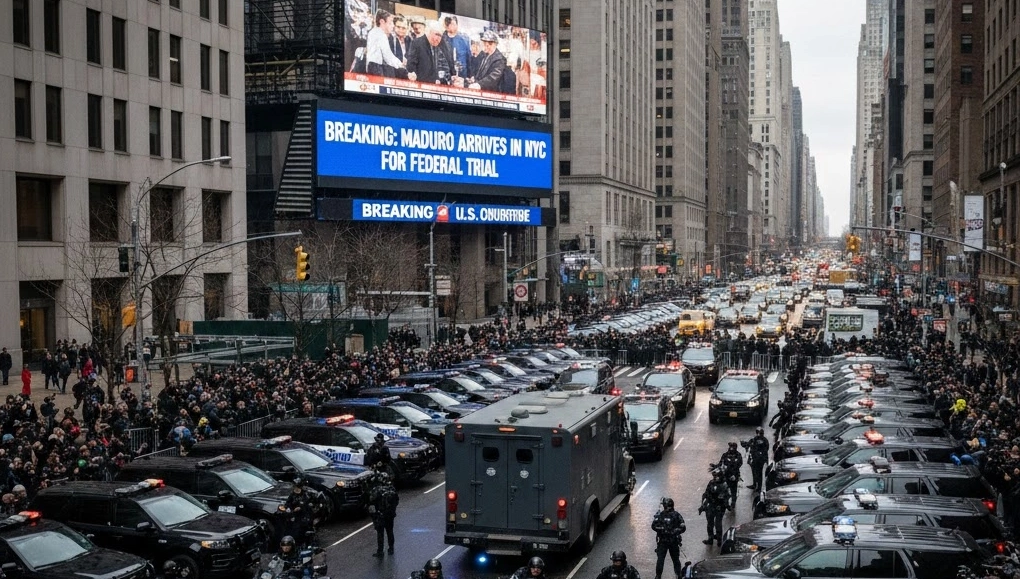
In early January 2026, Venezuela became the focus of a major global story. Explosions shook its capital, Caracas. Military strikes hit strategic sites. And the leader of the country, President Nicolás Maduro, was reportedly captured and taken out of the nation in a bold military operation. This marks one of the most dramatic events in Latin America in decades.
The situation is still unfolding. Yet already the world is reacting. Lines are being drawn between governments. Neighbors are alarmed. Ordinary Venezuelans are confused and scared, even hopeful.
This article explains the crisis in full detail. It covers the background, what happened, why it happened, what people are saying, and what the future might hold.
What Happened in Venezuela on January 3, 2026
In the early hours of January 3, 2026, a series of explosions shook Caracas, Venezuela’s capital. People in the city reported loud blasts and low-flying aircraft overhead. The explosions were not simple accidents. They hit military sites and bases around the country.
Residents reported the sound of aircraft and power outages near major locations. Chaos spread through the streets as people woke up to explosions and sirens sounding in the city.
Shortly after, the U.S. president announced a major military operation. The United States claimed that it had carried out a “large-scale strike” inside Venezuelan territory. In this operation, the U.S. said it had captured Venezuelan President Nicolás Maduro and his wife, Cilia Flores, and flew them out of the country.
This is the first time the United States has claimed to capture a sitting foreign head of state in South America since the U.S. invasion of Panama in 1989.
Why the United States Took Action
The U.S. government has long accused Maduro’s government of corruption, election rigging, human rights abuse, and drug trafficking. For years, Washington has added sanctions and pressure on Venezuela. It even offered a large reward — up to $50 million — for information leading to Maduro’s arrest. The U.S. government labeled powerful Venezuelan drug networks as terrorists and seized tankers it said were linked to drug flows.
In the months before January 2026, U.S. naval and air forces built a strong presence in the Caribbean Sea. Some strikes were aimed at what the U.S. called drug trafficking vessels and oil shipments. These actions increased tensions across the region.
According to U.S. leaders, this military operation was part of a wider campaign to end terrorism, drug trafficking, and corruption tied to Maduro’s government. And in a press announcement after the operation, the U.S. president said the United States would “run Venezuela” on a temporary basis until a safe transition could be arranged. Al Jazeera
Immediate Global Reactions
The world reacted quickly and strongly to the events:
Supportive voices:
- Some leaders from the Venezuelan opposition praised the capture, calling it a step toward freedom and an end to dictatorship. One opposition leader declared that this moment marked a new start for democracy in Venezuela.
Condemnation and concern:
- Many world leaders criticized the U.S. action as a violation of international law and a threat to regional stability. Governments in Latin America said this could spark further conflict and limit sovereignty. Some European nations called for peaceful solutions and respect for international norms.
- Several countries expressed deep alarm and stated that external military intervention sets a dangerous precedent if not rooted in international agreement.
These mixed reactions show how the event has divided the world into different political and diplomatic camps.
What Venezuela’s Government Says
Officials in Caracas rejected the U.S. narrative and strongly condemned the strikes.
The Venezuelan defense leadership described the U.S. actions as criminal aggression. They accused Washington of violating national sovereignty and spreading destruction across the country. The government demanded that the United States immediately show proof that President Maduro and his wife were alive and safe.
A national state of emergency was declared in Venezuela right after the explosions. The government said this was necessary to protect civilians and keep institutions functioning.
This shows that within Venezuela, the government still claims authority and control, even as the U.S. says it has captured the president.
Life on the Ground: Voices of Venezuelans
People inside Venezuela have shared their experiences on social media and local platforms. Many describe waking up to loud explosions and seeing helicopters or jets overhead. Some said the situation stabilized after a few hours, but the fear and uncertainty remain.
Some Venezuelans expressed worry about the future. Others said they hoped the event could bring positive change after years of hardship. Many families remain concerned about safety, food access, and the future of their communities.
These voices show that ordinary people feel deep emotions, not just political leaders.
The History of Duterte and Venezuelan Struggles
To understand the current situation, you need context.
Venezuela has been in economic and political crisis for many years. Once a wealthy oil-producing country, Venezuela’s economy collapsed under hyperinflation, falling oil prices, and corruption. Many Venezuelans lost jobs, savings, and access to basic needs like food, medicine, and electricity.
The government of Nicolás Maduro, who stayed in power for more than ten years, has been widely criticized for cracking down on political opposition, limiting press freedom, and consolidating power around loyal military and political elites.
Millions of Venezuelans fled the country as refugees, seeking safety and work abroad. The crisis became one of the largest migration events in the region in recent decades.
This long period of instability set the stage for the dramatic events of January 2026.
Political Impact Across the Region
More than just a national issue, the U.S.–Venezuela conflict has raised alarms among neighboring countries.
Colombia, which shares a long border with Venezuela, immediately strengthened its security at border points. Its government condemned the U.S. attack and said it posed risks to peace and security in the region. Analysts warned that the conflict could worsen security challenges already present, such as armed groups active along the border. Al Jazeera
Other countries in South America have expressed worry about refugee flows increasing again or violence spreading.
The crisis is increasing global debate about military intervention, sovereignty, and how powerful nations should deal with leaders accused of corruption and international crime.
Legal and Ethical Debates
The United States says its actions were justified by the need to stop illegal activity linked to drug trafficking and terrorism. In the U.S., some lawmakers praised the move as strong action against a dangerous regime.
Other politicians questioned the legality of the operation. They asked how the U.S. could conduct significant military action without clear authorization from its own Congress. This has triggered big debates inside the United States about presidential power and war powers.
International law experts also argue that military intervention is only legal under strict conditions, such as United Nations mandates or clear self-defense needs. Many critics say the operation falls outside those conditions.
These debates are shaping how the world views the crisis and what may happen next in terms of diplomacy and law.
Economic Stakes and Oil Industry Interests
Venezuela holds some of the largest proven oil reserves in the world. Its oil industry has been a central part of global energy markets and a key reason for international interest in the country.
After the January 2026 operation, U.S. leaders openly said the United States would be strongly involved in Venezuela’s oil sector during the transition period. This has both supporters and critics. Some see it as a chance to fix broken oil infrastructure and improve production. Others view it as control over natural resources without consent.
Who manages Venezuela’s oil industry will shape global energy markets and how Venezuela recovers economically.
What Could Happen Next? Possible Scenarios
The future of Venezuela now hangs on several possible paths. Each path depends on negotiations, political will, and reactions from both inside and outside the country.
1. A Peaceful Political Transition
Negotiated leaders may work to rebuild democratic institutions. Opposition figures may lead a transitional government. International support could flow in to restore stability and the economy.
2. A Prolonged Conflict
Fighting between political factions, military units, or external forces might continue. This could deepen instability and suffering for civilians. Migration could increase.
3. Regional Spillover
Neighboring nations could be drawn into tensions, especially if refugees move across borders or if armed groups react to the intervention.
Each scenario carries serious consequences. Governments around the world are watching to see what comes next.
Summary of Key Details (Table)
| Topic | Explanation |
|---|---|
| Explosions in Caracas | Multiple blasts and aircraft seen over Venezuela’s capital early January 3, 2026. |
| U.S. Military Strike | The U.S. launched a large-scale attack inside Venezuela. |
| Maduro Captured | U.S. leadership said it would run Venezuela temporarily during the transition. |
| U.S. Interim Control | U.S. leadership said it would run Venezuela temporarily during the transition. |
| Global Reaction | Questions raised about the legality of strike without full authorization. |
| Human Impact | Venezuelans face fear, hope, and uncertainty. |
| Legal Debate | Questions raised about the legality of a strike without full authorization. |
What This Means for the World
This crisis is a turning point in modern history. It may reshape how nations deal with corruption, human rights abuses, and international crime. It may change political alignments in Latin America. And it will certainly affect millions of Venezuelans and global energy markets.
The coming weeks and months will be critical. Diplomatic talks, political negotiations, and international legal actions are likely to shape what happens next.